KOTAK NEO • SHIPPED 2025
KOTAK NEO • SHIPPED 2025
Global Indices for Kotak Neo
Global Indices for Kotak Neo
Brought global market data in-app to support informed trading decisions for 10M+ users
Brought global market data in-app to support informed trading decisions for 10M+ users
ROLE:
Lead Product Designer (IC)
PLATFORM:
iOS, Android & Web
TEAM:
Product Designer (Me), Design Manager, 2 Product Managers, 3 Developers, 1 QA
CONTRIBUTION:
User research, Competitive analysis, ideation, end to end design, Prototyping, testing, handover
ROLE:
Lead Product Designer (IC)
TEAM:
Product Designer (Me), Design Manager, 2 Product Managers, 3 Developers, 1 QA
PLATFORM:
iOS, Android & Web
CONTRIBUTION:
User research, Competitive analysis, ideation, end to end design, Prototyping, testing, handover
CONTEXT:
CONTEXT:
Kotak Neo is a trading platform, where millions of users invest, trade, and navigate market decisions everyday.
Kotak Neo is a trading platform, where millions of users invest, trade, and navigate market decisions everyday.
They rely on real-time data and market movements to make informed decisions, on both mobile or web.
They rely on real-time data and market movements to make informed decisions, on both mobile or web.
PROBLEM:
PROBLEM:
But traders were missing critical global context
But traders were missing critical global context
Global markets move overnight. By pre-market open, those shifts have already shaped the direction of the session. Traders rely on this context before making decisions. Without it on the platform, they turned to external sources each morning to track global indices. Their frustration emerged from 3 key friction points:
Global markets move overnight. By pre-market open, those shifts have already shaped the direction of the session. Traders rely on this context before making decisions. Without it on the platform, they turned to external sources each morning to track global indices. Their frustration emerged from 3 key friction points:
They couldn’t make informed decisions
They couldn’t make informed decisions
Relying on external apps required a lot of context switching and additional work
Relying on external apps required a lot of context switching and additional work
Time spent gathering market context led to missed opportunities
Time spent gathering market context led to missed opportunities
SOLUTION:
SOLUTION:
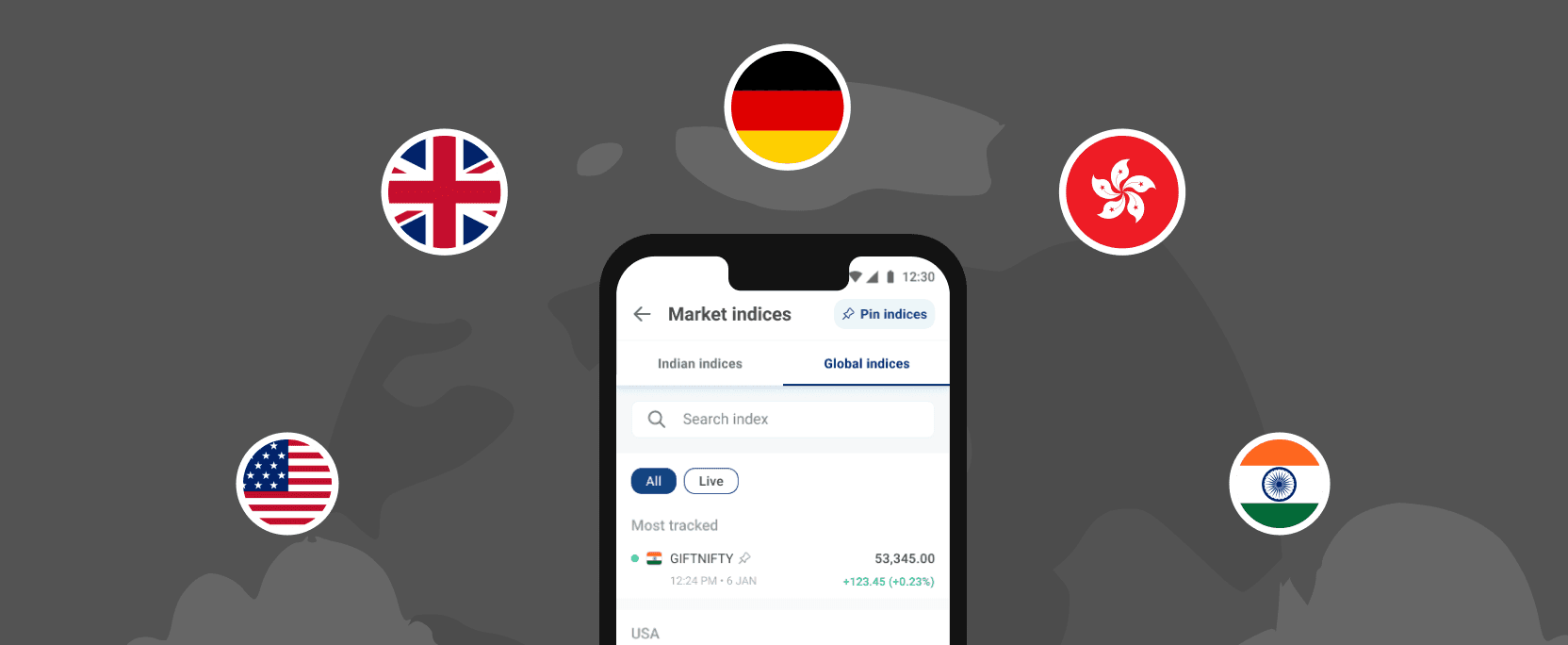
So, we brought global indices into the post-login experience, giving traders both visibility and control.
So, we brought global indices into the post-login experience, giving traders both visibility and control.
One tab for all indices, Indian and Global.
One tab for all indices, Indian and Global.
A live filter to surface what matters most.
A live filter to surface what matters most.
Track what matters to you
Track what matters to you
Pin and sort indices so the right context is always first.
Pin and sort indices so the right context is always first.
80%
open rate on launch, validating two years of user demand
open rate on launch, validating two years of user demand
DESIGN PROCESS:
DESIGN PROCESS:
Users consistently relied on external platforms
Users consistently relied on external platforms
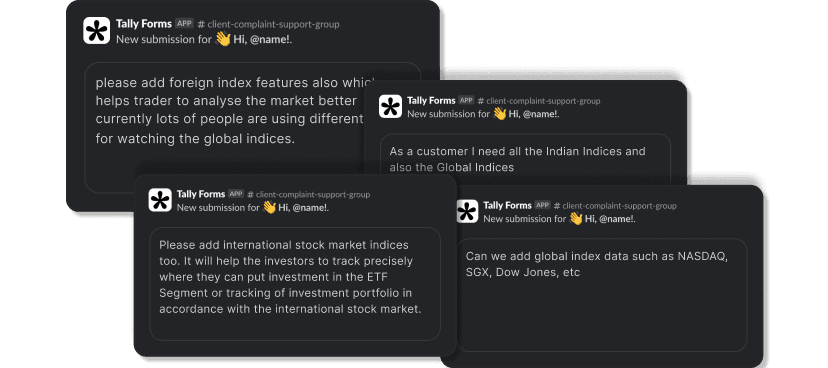
We started by understanding how traders prepared before market opened. Across different channels such as Telegram and support, users consistently kept requesting global market data. A Tally search of user requests data on Slack alone revealed 800+ queries over a short period. This unavailability of data led to users relying on external platforms to access global market data.
We started by understanding how traders prepared before market opened. Across different channels such as Telegram and support, users consistently kept requesting global market data. A Tally search of user requests data on Slack alone revealed 800+ queries over a short period. This unavailability of data led to users relying on external platforms to access global market data.
Business had the data, but it was not reflected in the user experience
Business had the data, but it was not reflected in the user experience
From a business perspective, the gap was equally important. Kotak Neo was already paying for global market data but it was not surfaced after login. This led to low utilisation of purchased data and an inconsistent experience, with users relying on external platforms for pre-market context.
From a business perspective, the gap was equally important. Kotak Neo was already paying for global market data but it was not surfaced after login. This led to low utilisation of purchased data and an inconsistent experience, with users relying on external platforms for pre-market context.
Early explorations
Early explorations
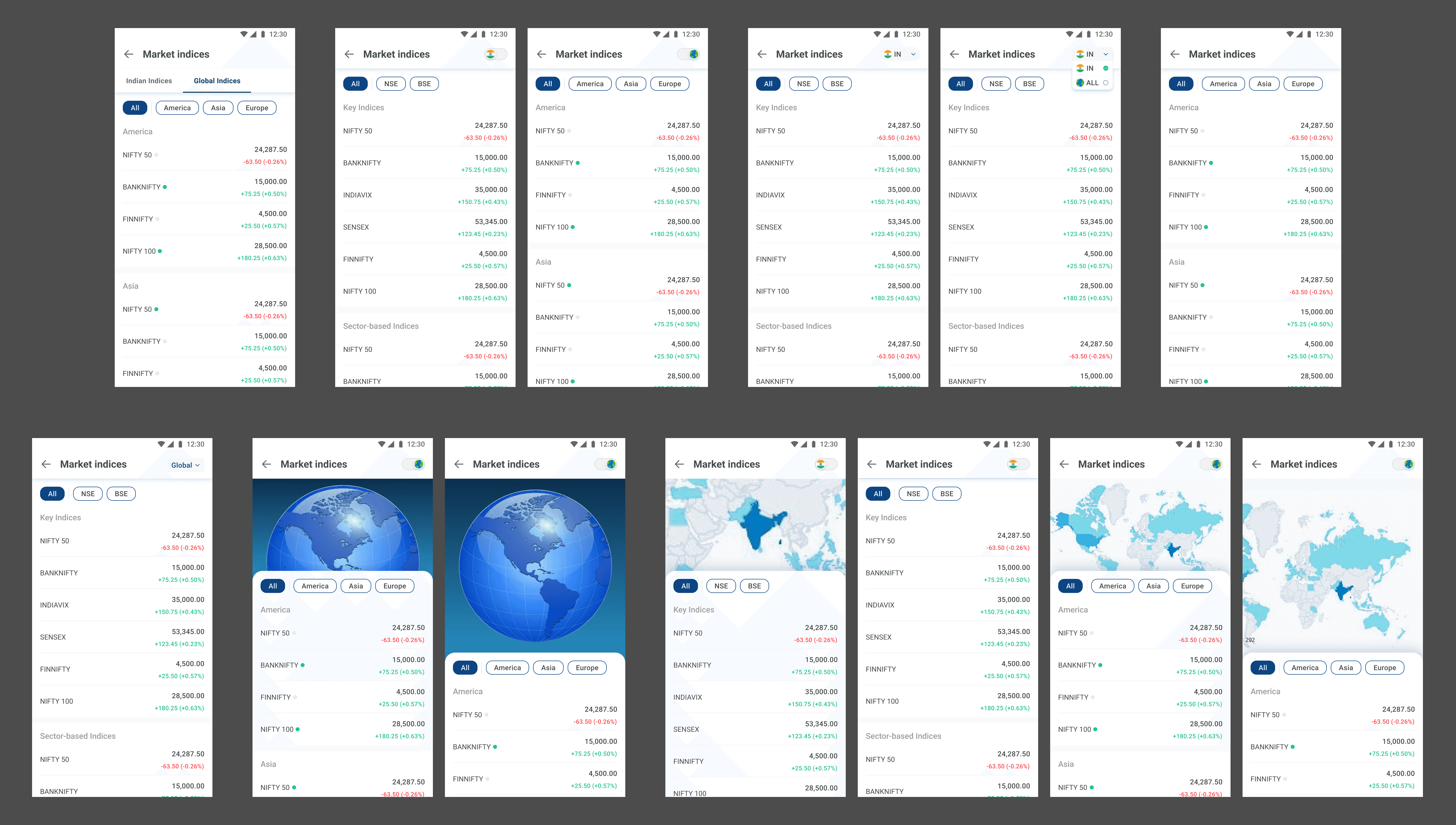
Some of the early ideations were more exploratory and focused on understanding where the entry point for global indices should live within the existing experience. We looked at whether this belonged inside the existing Market Indices section or as a separate surface such as a banner. Alongside placement, we also explored how much of the data should be surfaced upfront and how traders would make sense of it in a fast-moving context.
Some of the early ideations were more exploratory and focused on understanding where the entry point for global indices should live within the existing experience. We looked at whether this belonged inside the existing Market Indices section or as a separate surface such as a banner. Alongside placement, we also explored how much of the data should be surfaced upfront and how traders would make sense of it in a fast-moving context.
What we learned from user interviews
What we learned from user interviews
Talking to users revealed that simply surfacing global data was not enough. Traders needed to access it quickly at the moment of decision-making, without added effort or navigation. We also saw that relevance varies across users. Different traders track different sets of indices, and not all global indices hold equal importance for every trading strategy.
Talking to users revealed that simply surfacing global data was not enough. Traders needed to access it quickly at the moment of decision-making, without added effort or navigation. We also saw that relevance varies across users. Different traders track different sets of indices, and not all global indices hold equal importance for every trading strategy.
What market research revealed about existing solutions
What market research revealed about existing solutions
After doing a competitive analysis, we realised most trading apps either didn’t offer global indices or showed them in a static way. Across apps, there was little flexibility for users to shape this context, which made quick access harder during active decision-making.
After doing a competitive analysis, we realised most trading apps either didn’t offer global indices or showed them in a static way. Across apps, there was little flexibility for users to shape this context, which made quick access harder during active decision-making.
This led us to the challenge
This led us to the challenge
How might we surface the right global market context for every trader, in a way that fits into their decision-making flow?
How might we surface the right global market context for every trader, in a way that fits into their decision-making flow?
How constraints reshaped the direction
How constraints reshaped the direction
This context changed everything. Some of the earlier ideations didn’t hold once customisation came in. With constraints around the existing homepage such as not increasing scroll, and supporting personalisation, tabs aligned better and pushed us to use the existing Market Indices section as the entry point. Most of the ideation then shifted around how personalisation could work within this space.
This context changed everything. Some of the earlier ideations didn’t hold once customisation came in. With constraints around the existing homepage such as not increasing scroll, and supporting personalisation, tabs aligned better and pushed us to use the existing Market Indices section as the entry point. Most of the ideation then shifted around how personalisation could work within this space.
Usability testing revealed key gaps
Usability testing revealed key gaps
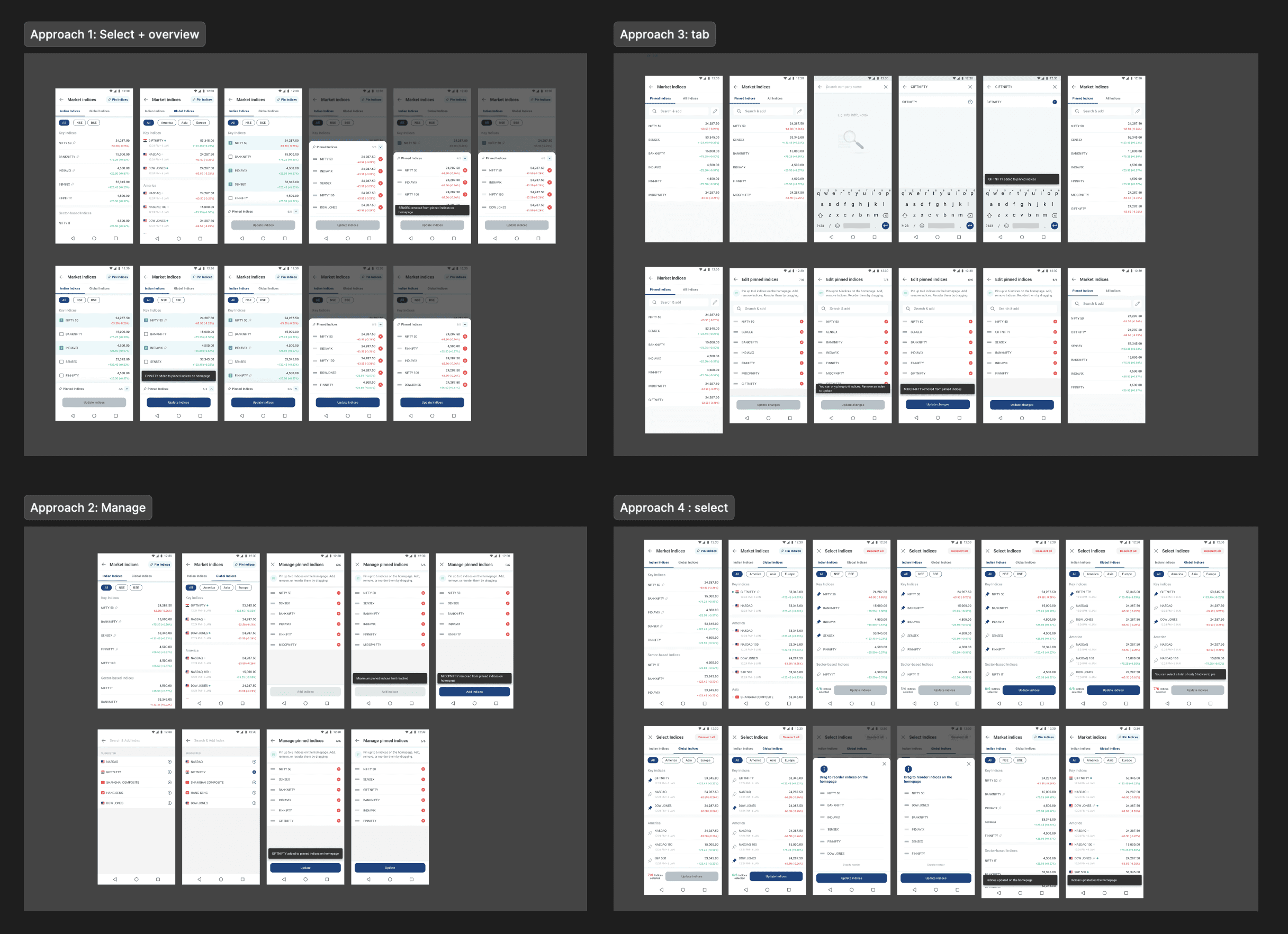
After testing two approaches with 8 users, we realised that users preferred an experience aligned with their existing mental model. This led us to move ahead with a tab-based structure and a pinning journey similar to adding items to a watchlist. We also identified a few gaps to address:
Fetch time needed to be visible since global indices update every 10 minutes
The entry point was not prominent and was often missed
Users needed clearer context while pinning and reordering
After testing two approaches with 8 users, we realised that users preferred an experience aligned with their existing mental model. This led us to move ahead with a tab-based structure and a pinning journey similar to adding items to a watchlist. We also identified a few gaps to address:
Fetch time needed to be visible since global indices update every 10 minutes
The entry point was not prominent and was often missed
Users needed clearer context while pinning and reordering
SOLUTION:
SOLUTION:
Onboarding
Onboarding
Since the design was integrated within the existing Market Indices section, we had to ensure users noticed it. We introduced step-based tooltips for product education and added Gift Nifty by default on the homepage to bring early visibility to global context.
Since the design was integrated within the existing Market Indices section, we had to ensure users noticed it. We introduced step-based tooltips for product education and added Gift Nifty by default on the homepage to bring early visibility to global context.
Structuring data for quick scanning
Structuring data for quick scanning
The experience was split into two tabs, Indian and Global. Indian included key and sector-based indices, while Global covered the most tracked indices across the US, Asia, and Europe. We also added a live tag and fetch time so users could understand data freshness.
The experience was split into two tabs, Indian and Global. Indian included key and sector-based indices, while Global covered the most tracked indices across the US, Asia, and Europe. We also added a live tag and fetch time so users could understand data freshness.
Enabling personalisation within the flow
Enabling personalisation within the flow
The pin indices button opens a selection state where tabs display the number of pinned indices for context. Users can select up to 6 indices across Indian and Global, then reorder them and update their homepage view.
The pin indices button opens a selection state where tabs display the number of pinned indices for context. Users can select up to 6 indices across Indian and Global, then reorder them and update their homepage view.
Learnings & Takeaways:
Learnings & Takeaways:
Understanding what users actually need is always more valuable than what seems right in exploration.
Understanding what users actually need is always more valuable than what seems right in exploration.
Knowing what is technically possible shapes better design decisions from the start.
Knowing what is technically possible shapes better design decisions from the start.